Episode 259: Simplifying AI for Global Customer Impact with Srinivasan Raghavan
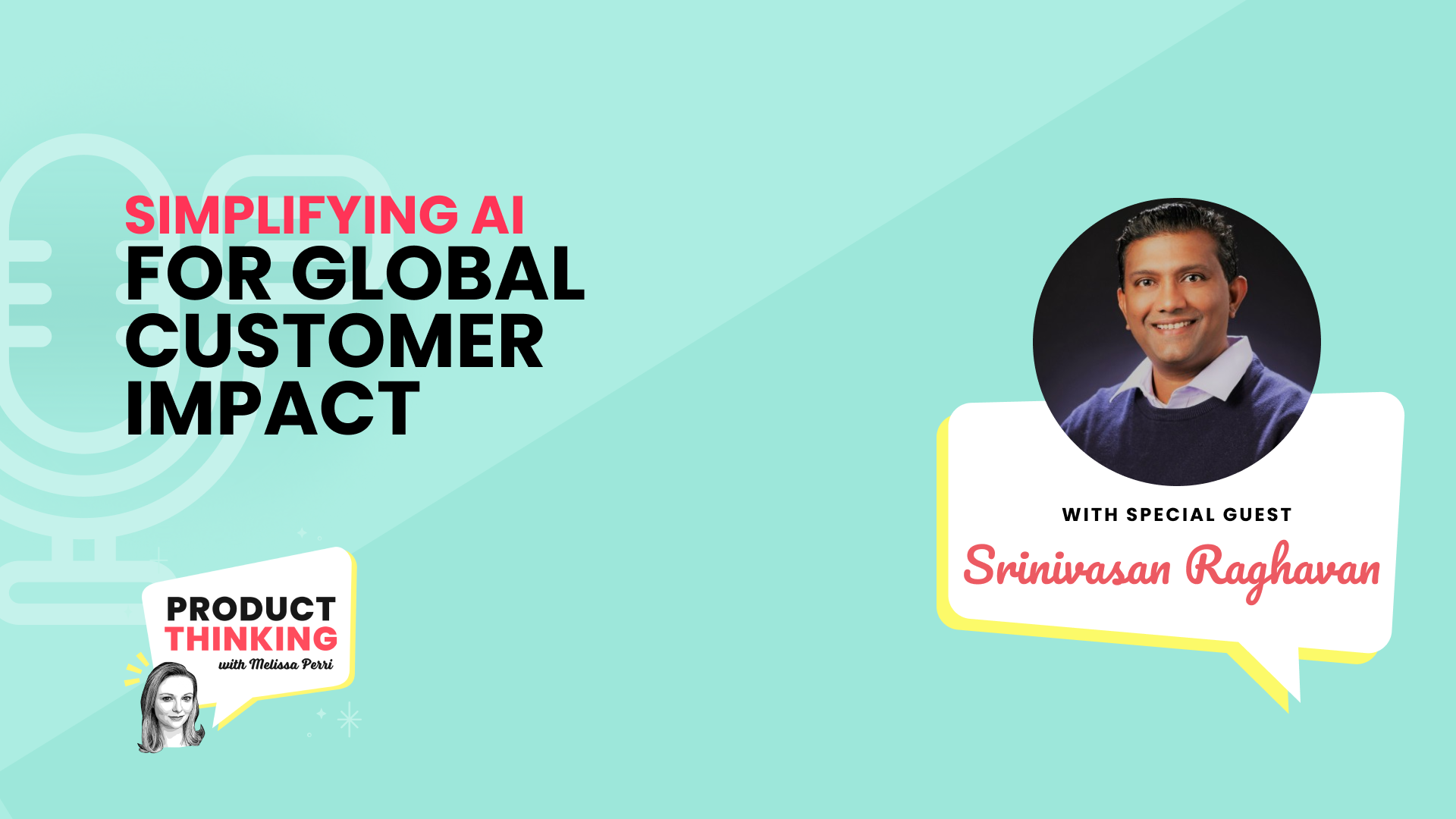
Srini Raghavan, Chief Product Officer at FreshWorks, joins Melissa Perri to discuss the evolving role of product management in the age of AI. He explores how product managers are transforming into "product builders" with AI as a catalyst for more integrated roles, collapsing traditional processes, and enabling rapid prototyping.
Srini dives into the impact of AI on enhancing customer and employee experiences at FreshWorks. He shares insights on how AI agents are handling repetitive tasks, improving satisfaction, and delivering real outcomes through a relentless focus on customer needs.
Curious about how AI is reshaping product management and the role of product managers? Tune in to hear Srini's insights on leveraging AI for creating uncomplicated user experiences and driving outcome-focused innovation.
You’ll hear us talk about:
05:15 - Transforming Product Managers into Product Builders
Srini discusses the shift towards product managers becoming more involved in design and prototyping phases, with AI reducing the need for separate UX and engineering inputs early on.
18:45 - Enhancing Experiences with AI Agents
Learn about FreshWorks' approach to using AI agents to handle repetitive tasks and improve user satisfaction, providing a more human-like experience.
28:30 - Delivering Uncomplicated User Experiences
Srini explains the importance of simplicity in product setup and management, aiming to serve a diverse range of customers with straightforward user experiences.
Episode resources:
Srini on LinkedIn: https://www.linkedin.com/in/srinivasan28/
Freshworks website: https://www.freshworks.com/
Check our courses: https://productinstitute.com/
Follow/Subscribe Now:
Facebook | Instagram | LinkedIn
Episode Transcript:
[00:00:00] Srini Raghavan: AI has acted as a catalyst for the product managers to become more product builders. What I mean by a product builder is historically, or traditionally the product management has been that, look, we'll figure out what the customer needs are, we'll talk to customers, and then we'll get user experience, people to build a prototype or a design. We'll initially start with some user research, then we'll have an architectural discussion. Then engineering will start building things. Then we'll start testing things, right? What AI has allowed is to collapse this whole thing. And I strongly think we will have a lot of product builders going forward. Product management will morph into a product builder where you can do user research, design, build the product specifications and the design. stay close to the customers, understand their world deeply and connect everything that we do, whether it's strategy, roadmap, design, or AI and backed by the real outcomes that we deliver for them. And the tools and trends will change. Today we have figma make, [00:01:00] tomorrow it could be something else, could be lovable or cloud code, all these things have means to an end. But the mindset of being outcomes driven and being customer obsessed will always be relevant.
Intro
---
PreRoll: Creating great products isn't just about product managers and their day to day interactions with developers. It's about how an organization supports products as a whole. The systems, the processes, and cultures in place that help companies deliver value to their customers. With the help of some boundary pushing guests and inspiration from your most pressing product questions, we'll dive into this system from every angle and help you find your way.
Think like a great product leader. This is the product thinking podcast. Here's your host, Melissa Perri.
Melissa Perri: Hello and welcome to another episode of the Product Thinking Podcast. Today I'm excited to have Srini Raghavan with us.
He's a Chief Product Officer at FreshWorks driving the growth and innovation of AI powered [00:02:00] customer and employee experience solutions. Their work impacts 75,000 companies worldwide, including big names like American Express, Disney, Databricks, and the Los Angeles Dodgers. I'm thrilled to dive into his insights on how the industry is changing and explore his strategies for enhancing customer success. Welcome, Srini. It's great to have you.
Srini Raghavan: Great, Melissa. Thanks for having me. I'm looking forward to the conversation.
Melissa Perri: Me too. And I think we've got a lot to dive into on AI as well.
Srini’s Journey to CPO
---
Melissa Perri: So I'm curious what led you to becoming the Chief Product Officer at Freshworks?
Srini Raghavan: Actually I'm an accidental product manager, believe it or not. As a software engineer, I actually started a support software engineer where I was carrying a pager. And and when the systems are down, that's when they page me and I would attend to those problems. So that actually gave me a deep appreciation for for the impact that the products have on the customers.
And I would wake up in the middle of the night and fix their problems. And later on I became an engineer. So I would I would design the products. Gave me deep and then I went into other [00:03:00] functions. It's the main thing that this taught me is how to build great products and not just to design them on a slide. And over time I found myself more and more drawn to the why behind the what we are building. The customer problem, the business outcome. And that is what pulled me into product management. I had a pretty diverse journey before I got into product management. I worked in I worked in finance, I worked in investor banking, I worked in product strategy, uh, and corporate development.
Different companies, which gave me a 360 degree view of how products are built, especially in a B2B SaaS company, are built with with a close collaboration and coordination between different functions in a company and that that. For example, at five nine I started in copper strategy.
Then I went into product management. I led product management and user experience there, and we focused heavily on AI and automation. So we built up. Workflow automation and agent assist, which were essentially to [00:04:00] make the users in the contact center way more effective, which is the human agents and the leaders. I, I also answered in corporate development there, I led three acquisitions which taught me a lot about how to build versus buy in, how to make those decisions on what we build versus we partner versus the companies that we could potentially buy. Then at RingCentral as a Chief Product Officer, I had a chance to work on a broader communication, collaboration suite, again, with AI and automation as the key themes.
And that experience of operating at scale across multiple product lines and segments was a big stepping stone. So I would say in the last 10 years where I've been a product manager, the team has been building a lot of the, and automation products, which started my journey at at five nine, then at RingCentral.
And now this is what naturally led me to be at at FreshWorks. And I'll tell you more as we go along. At FreshWorks we have a generational opportunity for us. ~We're at the center of I,~ I'm the Chief Product Officer here, I lead this strategy, product strategy, user experience and operations across the two major product lines that we have, [00:05:00] customer experience and employee experience. What really attracted me to come here was the opportunity to bring AI powered enterprise grade experiences to a wide range of companies. You mentioned some of those customers, at the introduction, we have 75,000 customers in 120 plus countries. But we do it, we build our products in a way that's accessible, simple, outcomes driven, we call it the uncomplicated way of providing experiences to our customers.
Melissa Perri: Wow. That is a lot of customers too. And that's a really big reach across 120 different countries. When you're thinking about servicing that many customers as well, what do you try to instill in your like product strategy and philosophy to make sure that it's consistent and that you can serve so many different types of people?
Srini Raghavan: Yeah, I think the core of our philosophy is serving the end user. We have 75,000 customers. We have a ton of human agents that are using us, 2 million plus agents or so that [00:06:00] are using us. A bunch of leaders and millions of end users ~ their products are~ are using our products, right?
So we're a B2B SaaS company, which means our products are used by our end customers, which ultimately they use to serve their end customer, their end users, right? So the philosophy is, the number one thing that we look at when we are designing anything is how do we deliver seamless and uncomplicated experience to the end users and to the customers that are using our products. That is the number one thing that we consider, and simplicity, user experience, and not just of using the products, but setting up the products, using them and on an ongoing basis, how they can take advantage of the ongoing innovations that we get to our customers on a monthly basis. That's what we look at. So it's the user experience and usability is at the core of everything that we do.
Melissa Perri: So in serving a lot of those customers, you talked about how you wanna make a great experience, especially for the end user. AI is [00:07:00] changing a lot of the ways that we do that, delivering value to our customers, also the way that we do our jobs as product managers. Can you talk a little bit about how your thinking about incorporating AI at freshworks?
Srini Raghavan: Yeah, I'll talk about it in terms of how we are leveraging AI for building products. I strongly believe that what AI has acted as a catalyst for is for the product managers to become more product builders. What I mean by a product builder is historically, or traditionally the product management has been that, look, we'll figure out what the customer needs are, we'll talk to customers, and then we'll get user experience, people to build a prototype or a design. We'll initially start with some user research, which a user research team will do. Then we'll have an architectural discussion. Then engineering will start building things. Then we'll start testing things, right?
AI’s Impact on the Role of Product Managers
---
Srini Raghavan: What AI has allowed is to collapse this whole thing. And allowed the product manager to be more of a product builder. And I strongly think we will have [00:08:00] a lot of product builders going forward. Product management will morph into a product builder where you can do user research, design, build the product specifications and the design.
And finally you can even, some of them could even do an initial prototype and test it with customers before you take it to engineering to actually build a production gate product.
Melissa Perri: Ready to level up as a product manager. Product Institute offers online courses that teach you the strategy, tools, and data skills you need to make confident product decisions. Access expert led videos, practical worksheets, and proven frameworks. All at your own pace. This holiday season, get 40% off all courses with code Holiday through December 31st. Visit product institute.com and start thinking like a great product manager. Training teams, email info at productinstitute.com for group options.
Srini Raghavan: Just as a fun example, this morning I presented our 2026 roadmap to to our CEO and the rest management team.
And [00:09:00] every time we do this in a bunch of slides and in some applications, et cetera. Then I thought, okay why not do a fun little project? So I used Gemini to build an app that can make a roadmap into a living and breathing application that can be accessed by all the stakeholders across the company.
So that was a fun little project for me. So I went from being a product manager to a product builder. 'cause literally I was a single person that took the inputs, created the app, and published it to the to our csuite to look at what the roadmap is. And that was a fun little project. I think these kind of projects are evolving from fun little projects to becoming actual production gate.
We use Figma make for design prototyping. We use first initial prototyping of things that we are building. So there's a lot of tools that product and the engineering and the user experience team are using. Some of these are still in early stages, right?
Some, and some are in higher levels of adoption, some are not there in terms of adoption. So what we are [00:10:00] thinking through is how do we create like a formal, training program for the entire product team to evolve from being a product manager to being more of a product builder. So just to add to this, there is, there's actually a customer value that you get.
Melissa Perri: Mm-hmm.
Srini Raghavan: you know, you sit in front of a customer and customer says, Hey, can you do this? And, two days later, you come back to them and say, Hey, is this what you wanted? This is an amazing thing, right? Like previously it used to take like months and months. Now you can do this in like a day or two, and that's an amazing outcome for customers.
Melissa Perri: Yeah, I love the rapid speed that we could turn this stuff around in and we could test it. One of the questions I was getting last week, I was speaking at some. Product conferences in different companies and a lot of the leaders were asking me especially about like rapid prototyping or now that we have cloud code, how you see the role of product manager changing, but also how you see the surrounding roles.
So how do you see the roles of like UX evolving, how product managers will work with developers in the future? Where do you plug them in and how do you think it's gonna change from what we do now?
Srini Raghavan: [00:11:00] I think every role is going to evolve. Like we have this discussions in our own team where user experience, user research, product managers. Everybody is moving and can move much more faster with the AI tools that we are having and be more way more efficient. so for example, for early stage product prototyping, we don't necessarily need to have the user experience designers don't necessarily actually need to have any PMs.
If it's a frontend heavy product where the user experience is the key, they can build the prototype in Figma and they can directly work with the engineering team to get that to production. So, like I said, every role, these terminologies that we have today, which is user experience, user research, user experience designer, product manager, all these roles are starting to blend.
I think in the future you'll a, a really good, it'll all become instead of a really good product manager or a user experience designer, you would have one good person, that's called a product builder. And this product builder will have the skills [00:12:00] of user research, user experience design, building a product and working with engineer to get the product to to production.
Some of them, some of the more advanced ones will actually even build a product and ship it.
Melissa Perri: Yeah, I, it's so funny when in New York City or in around like 2010, I remember we always had these roles called product designers at some of the smaller companies, and the product designer was like a hybrid product manager and UX designer role. And as we kept going, I saw them disappear out there.
But that's how I started, was like a product manager and UX designer in one. And I was decent at the ux. I got better at it over time. But the product management is where it thrives. And as these companies got bigger and bigger, I feel like the roles split out more and more. But in the smaller companies, I found it particularly great.
For product designers because you could take it all the way through, like from product management all the way through user experience if you had enough of those skills. But I just never saw them hired as much over time. It's like they very much [00:13:00] formally separated and it was like no one could, if you do ux, you don't do product.
It's like there is no hybrid role. You have to stay out. And I always thought that was very strange.
Srini Raghavan: I completely agree. I think that's how typically it has been in in B2B SaaS and somewhat in B2C companies as well. But those, what AI has done, it's acting as a catalyst to bring those things. The nimbleness that you mentioned that smaller companies have, that nimbleness is is going to come to the larger companies as well, some of the larger companies. And I feel like larger companies are like a conglomerate of smaller products, right? Like smaller teams that build different products. So I think that that nimbleness is going to come back and AI is going to act as a catalyst for that to happen. I consider myself to be to be much more of a product manager than a UX designer.
But now I'm getting better and better at UX design and these tools that are there help me and rest with the product team in becoming a lot more effective at it. And vice versa on the user experience design as well. I see UX designers coming up with amazing ideas on how we can improve the [00:14:00] products and what business values that we can deliver to our customers.
And they do amazing job of doing user research. So these roles are starting to blend and we will see this more and more happen going forward.
Melissa Perri: Yeah, and I, I think it's going to be important as well for what you were just saying, like product managers to learn a lot about the user experience parts too. I've met a lot of product managers who are not good at user experience design, and that's the part that makes me fearful about the rapid prototyping landscape because I think.
Figma make and all of those things level, they're great at the UI components, but then if you don't actually tell it how to do the experience, they don't string 'em together very well. It could be very disjointed and I worry about product managers advocating all of that just to, that prototyping piece and saying, oh, they'll figure out the ux, but I like how you were talking about it, where you're getting better and you're learning and you're stepping through it.
Srini Raghavan: That's right. We actually use a bunch of tools. We do live research with our customers, our end users. Like when we say customers, there's a person that [00:15:00] sort of buys your product and then there's a person that uses your product. Typically, those two are not the same in a B2B context because you have A procurement person or a head of IT or head of support that buys the product, but then the agents and the end users are using your product. So we actually talk directly to our end users user. We do user research by talking to our end users, and those conversations happen across. Across the board, we have 200 plus product managers and user experience people that talk to our end customers.
But all the data is synthesized and we have a tool those conversations are recorded, they're synthesized and we get those insights into building the actual product when we are in the ideation phase. So it's a loop. Look, AI can help in doing the design, but the humans is what make it more effective by bringing those insights from the conversations from real users into making this design way more effective.
Melissa Perri: I love that. I love that you're ensuring that actual, real insights are getting in there as well.
Srini Raghavan: Yeah.
Melissa Perri: When you think about the landscape of AI, there's also the [00:16:00] components of how do we think about how it improves the value for our customers? And we talked about speed as one of those aspects too. But what other things have you been looking at using AI for to help your customers achieve their value?
Delivering Customer Value Through AI Agents
---
Srini Raghavan: Yeah. At FreshWorks, lemme talk about how we are helping our customers at FreshWorks across the customer experience and the employee experiences. We think of AI in in roles that can help, uh, people. I think of it as we have AI agents that helps the end users think of that as your concierge service that's available, and that helps you right away, a co-pilot.
That is your, that is a personal assistant to the human agents, whether it's a support agent or an IT agent or an HR agent. It's like your concentrate that's sitting right with you, helping you to solve the problems that you're getting right away. And then AI Insights , that is helping the leaders get the insights into what's happening. So number one is the AI agent automatically handles a repetitive defined tasks both on the [00:17:00] customer experience side and on the employee experience side.
It resolves common issues, call it like auto triaging it tickets or answering simple HR questions or support questions, right? Think high volume questions that are immediately providing service to the end users. So the drivers we see, for example, we see deflection rates from our customers.
They see deflection rates go up all the way from 20% to 60, sometimes even 85%. the benefit is not necessarily that these questions are deflected, but the end user. Think about the last time you were on a travel website and you were trying to get information on the phone, whichever modality that you use, whether it's email or chat or phone.
Sometimes you are on hold and it takes time for connect with with the agents on the other end. What AI agency is doing it's giving you that human-like experience. It's improving the customer satisfaction. So that's the outcome that our customers are getting. So we have seen customer satisfaction improve. We have seen deflection rates improve all the way up to 70, 80, 85%.
On the copilot side, on the other hand, it's augmenting the human. [00:18:00] It's helping the agents respond faster to emails, faster to chats. It's summarizing the conversations. How do I, how has the the other agents or other humans have responded to this ticket? And it brings that intelligence in. And it helps the IT and the HR agents to complex workflows. And finally, the insights that I mentioned, Freddy AI insights. It acts as a analyst. It's offers sub insights from all the signals that are hidden in the tickets, conversations in the logs, et cetera.
Think of it like finding a needle in a haystack. Think of it like a chat GPT for your enterprise. These days, whenever I have a question I go and ask Chat GPT, Hey, how do I do this? My daughter the other day asked me about, what is mitochondria? It's okay, I'll ask Chat GPT, what is mitochondria?
And it gave me, and explained to me like a 5-year-old, that's what our AI insights analyst product does. You can ask any question, and it'll give you information about the data that's that's in your enterprise, whether it's on the IT side or the support side.
And something that's unique about Freshworks is that we serve both the customer facing teams [00:19:00] and the internal employee facing teams. So what that gives us is our AI is sort of a bridge between the external communications and the employee communications, and it can be adapted for the IT, HR, and the operations use cases. So it lets unify the experiences and reuse the intelligence. So we call it the connected intelligence. It's a connected tissue across the enterprise.
Which delivers consistent outcomes across the employee and customer experiences. The outcome is faster resolutions, better experiences, and way more productive teams.
Melissa Perri: And one of the the features that you're talking about here too is the AI agent Studio, that you've built. And how did you come about developing that? How did you like test that it was giving the right answers? Tell us a little bit more about the studio, but what was the process like to actually build that into your platform?
Srini Raghavan: Yeah, very good question. I'll start by giving you a really good example. I talked to a customer a couple days back. It's a payments company and the payments company has grown by over the last two, three [00:20:00] years. And they've been using our AI agents, and this is the best compliment that I got.
They said, Hey, we've been using your AI agents for the last year or so, and somebody tried to hack into your system. And they started asking questions about our IP address, how it functions, and it wouldn't answer any of those.
Building and Scaling AI Agent Studio
---
Srini Raghavan: It stuck to their guardrails and they said I don't know how you guys built it, but your AI agency's way better than the end user tried to trick them, or the hacker tried to trick them, but it wouldn't trick even a human. That's the highest level of compliment
Melissa Perri: yeah.
Srini Raghavan: That I've seen. So we always start, when we start building the agents, we start with a simple but a very powerful question of what does a customer want to achieve? What we heard was the, we want the AI agents to actually understand my business, work across my systems, and save to deploy, without needing a huge technical lift.
So they don't need a PhD. So that's, so our design principles, when we started building this where it has to be no code / low code first, which means the business and [00:21:00] operations team should be able to design, configure, and maintain the agents with minimal engineering support. The example that I gave you earlier, this person was running the support center.
No technical pro whatsoever, and this person was able to design and deploy the AI agents.
Melissa Perri: Cool.
Srini Raghavan: Second is the unified knowledge and context, right? The agents need to access the right knowledge, the data, and the history across various systems like CRMs. ITSM, HR systems and these systems are, they shouldn't live in silos, so it brings together all the systems.
We have integrations with 50 plus external systems. And the third one is multichannel and multimodal. What I mean by that is the same agent. Once you build an agent, it should work across different channels such as chat, email, voice and it has to be consistent and it has to flex between using voice or text, that's multimodal. And it has to have enterprise grade guardrails, which is governance, security, data residency, and what we call as responsibly AI controls had to be built from day one. And when you do all of [00:22:00] that is when you get these kudos. So we initially tried this small set of design partners.
We traded very quickly. Our internal teams are a customer as well. So we have our own IT team, our own support team that uses and we instrumented everything in such a way that we could see what worked, what didn't and which helped harden the product. Today, it's AI Agent Studio is a platform where you can orchestrate agentic workflows across employee experience and customer experience, along with the outcomes in monitoring the performance of how those agent AI agents are doing.
Melissa Perri: And what's unique about your agentic workflows that you incorporated into here?
Srini Raghavan: So already touched on three things, right? It's easy to build, easy to use, easy to monitor. That's probably the three things I would say, but they're all, they're outcome driven. His. If you look at the other AI agents that are out there, they are like step driven. In our case, you define the outcome, you define the business outcome.
The business outcome could be, Hey, can you resolve this ticket or provision access to these IT tools, approve a [00:23:00] refund, and the workflow orchestrates the steps, the tools and the human involvement included to get. They're cross system by design, which means our agents and workflows can call into multiple systems.
Freshworks product. It could be fresh product, which is fresh desk and fresh service, or it could be third party tools. So that the automation actually reflects how work happens in real companies. 'cause we've seen that in our customers. They use multiple systems of record, so it orchestrates across multiple systems of record.
They're human-in-the-loop friendly, which means our AI agents support approvals, handoffs, and they are, they can go into copilot more so that you can blend automation with human judgment in a controlled way. They're governed and observable, which means you can see which flow workflows are running, what they're doing, how they're performing, their ability to set policies and limits.
In short, we're not just automating single interactions, we're automating end-to-end journeys for our customers and their end users, which could be employees or their customers. They have early access to our workflows, which we [00:24:00] launched in June last year. They report an average deflection of 65%, sometimes achieving up to 85% of the service issues have been resolved by your agents.
Scaling AI While Staying People-First
---
Melissa Perri: PMs make great investors. If you're a product leader, curious about angel investing, check out Angel Squad. It's where over 2000 operators from Google, Meta and Apple learn to invest in high growth startups alongside Hustle Fund. I've been a member for years and highly recommend it. They've given me a few 30 day guest passes to share
so head over to go.angelsquad.co/melissa and make sure to act fast as the passes are limited.
With these types of AI agents that you're building, it sounds like they could take in an immense amount of data. How do you get started building something that could integrate with all these different tools, has to go through massive amounts of data. All of these like different stuff. How did you think about where do we start and how do we test this to then scale it? What was that process like?
Srini Raghavan: This is a question that our customers ask is, Hey, how do I start my AI [00:25:00] journey?
Melissa Perri: Yeah.
Srini Raghavan: It starts with a simple thing. Identify a very simple use case that you want to use for automation you can go into the agent builder that we have, and you can describe what you are trying to do.
You can give it a persona and you can deploy. You can handle simple use cases to begin with, right? As the simple use cases, as you get more confidence and simple use cases are getting answered, you can slowly scale it to other use cases because as I said, it's tightly integrated with the human in the loop.
For simple questions, the AI agent can answer and you can instruct it to answer simple questions. For more complex ones, you can go to a human agent. So the human agent can answer the questions. So there is this virtuous loop of human, we call it people first AI, which is why the people first AI, the concept, the people make decisions and people are driving AI to be more effective, according to how their pace of AI adoption should be.
Melissa Perri: I love that and I love that it's the people first part of AI 'cause everybody always thinks it's just gonna replace them [00:26:00] all. But yet it sounds like you have a lot of people who are actually using this. Like you're augmenting people to be able to deliver the support with AI.
Srini Raghavan: That's absolutely right. Yes. So we have hundreds of customers that are using it. Everyone is unique. We have customers such as Gale's Bakery which has it's an SMB customer to a very large customer that I mentioned a payments giant, iPostal. We have multiple different customers of different sizes that are using it.
Everybody is in their own journey. They are some adopting it really fast, some are cautious about it. Some want to show me before I use it more. So you have companies all the way from Gale's Bakery to Seagate to Databricks, all the customers that you mentioned, larger companies that are using it, and smaller customers that are that are also using it.
What we believe in is it's like I said, it's people first ai, so people decide which use cases you use it for, what pace at which I want the service [00:27:00] delivery to be automated and which places I want to be automated.
sorry, one last thing I'll end by saying our motto is uncomplicated right, so we deliver uncomplicated solutions to businesses of all sizes, right?
Melissa Perri: Yeah, interesting. 'cause it's such a it's such a span, right? Like you're small businesses or what you've been mentioning here versus like your Databricks versus these large corporations. Where do you think the uncomplicated part comes from? What do you really focus on there to make sure that it can span everything, but still be powerful?
Srini Raghavan: It starts with the user. So remember, if you are a, ultimately a user, whether you are in Seagate or Databricks, or whether you are in Gale's Bakery, the end user wants a uncomplicated system all the way. Like I said, three things to setting it up, to using it, and then monitoring the usage. So think about it this way, right?
Formula One, or any other car. What we are doing is we have the, we are giving the car to [00:28:00] the customer to use and it's super simple to use and they can use it however they want. Whether it's a large customer or a small customer, whichever size of the customer actually is, it doesn't really matter.
this is where we see some of these larger companies that have this bloat where you'd have consultants come in and set it up and it takes a ton of time to get up and running and it takes weeks of training. So none of that exists for us. You can just get it up and running in a few hours.
Staying Customer-Centric in a Fast AI Landscape
---
Melissa Perri: I love that. I love the simplicity and I think it's so nice, especially for larger companies too. I always get into, I feel like arguments or I get questions from people that are like, Hey. If it's just an internal tool, does the user experience matter, right? Like if my, if my employees have to use it, my customers aren't seeing it.
Do I really care how easy it is to use or how nice it looks for them? And you are making an experience for those employees and you're focusing on the simplicity, which I think is amazing.
Srini Raghavan: Absolutely.
So there's if you ask any IT team in the world, who's your [00:29:00] customer? They would say, my employees are my customers.
Melissa Perri: love that.
Srini Raghavan: we have our own internal, our own CIO that says my, my CSAT is driven by your satisfaction because I'm an employee and he's I'm his customer. So he says, as long as my customers are happy, that's what drives their customer satisfaction.
And same thing applies to support centers on the CX side, right? Customer satisfaction is the most important thing, whether it's internal or external customer.
Melissa Perri: And Srini, when you are encouraging your product managers to maintain that customer centricity, especially at the rate of everything evolving like we've got million different AI tools coming out. All this, new technology, the market's moving really fast. What types of things are they doing to make sure that they don't lose sight of that customer?
Srini Raghavan: I think the number one thing is they need to be relentlessly outcome focused. I encourage all my product managers to talk to customers. I personally talk to at least five to 10 customers per week, and that's like at least a third to half of my time every week is is talking to customers. [00:30:00] Ultimately, the product manager's job is to be the champion of the customer to the internal teams, whether it's engineering support, professional service, any of those, right?
So stay close to the customers, understand their world deeply and connect everything that we do, whether it's strategy, roadmap, design, or AI and backed by the real outcomes that we deliver for them. And the tools and trends will change. Today we have figma make tomorrow. It could be something else, could be lovable or cloud code, all these things have means to an end. But the mindset of being outcomes driven and being customer obsessed will always be relevant.
Career Advice
---
Melissa Perri: I totally agree with that. Srini, my last question for you. If you could go back early in your career and give yourself one piece of advice, what would it be?
Srini Raghavan: Melissa, that's a great question, because I ponder about this all the time, but I have young kids and and I want to give them advice. So the first thing I would say is fall in love with the problem, not your solution. And learn the [00:31:00] language of business early, revenue margins, unit economics, so that you can connect your product decisions to business impact.
Third is invest in storytelling and influencing. Not just analysis. Great ideas need great champions. And finally, be comfortable with ambiguity and change. The best opportunities often look messy at first and maybe the most important. Enjoy the journey. Product management is a team sport. Future build matter as much as the products that you ship.
Melissa Perri: I think that is fantastic advice for people out there, and I really love your connection of the business language for product managers, has been a hot topic lately. Thank you so much, Srini, for joining us. If people wanna reach out and follow you, what's the best place to go?
Srini Raghavan: They can reach out to me on LinkedIn. My handle is, srinivasan28. That's S-R-I-N-I-V-A-S-A-N 28. And my Twitter handle is S-R-I-N-I-Y-E-R, on Twitter. Those are the two places they can, they [00:32:00] can reach out to me.
Melissa Perri: Okay, great, and we will put those links on our show notes at productthinkingpodcast.com. Thank you so much, for listening to the Product Thinking Podcast. We'll be back next week with another amazing episode. Make sure that you like and subscribe so that you never miss out, and we'll see you next time.